Food Hunt Level 1027 Walkthrough
ExpertStuck on Food Hunt level 1027? Follow the full 37-block clear of the board: a five-block opening, a yellow block frozen for nearly three minutes, five hidden same-color refills, and a cyan finish that empties the board at 4:36.

Level board
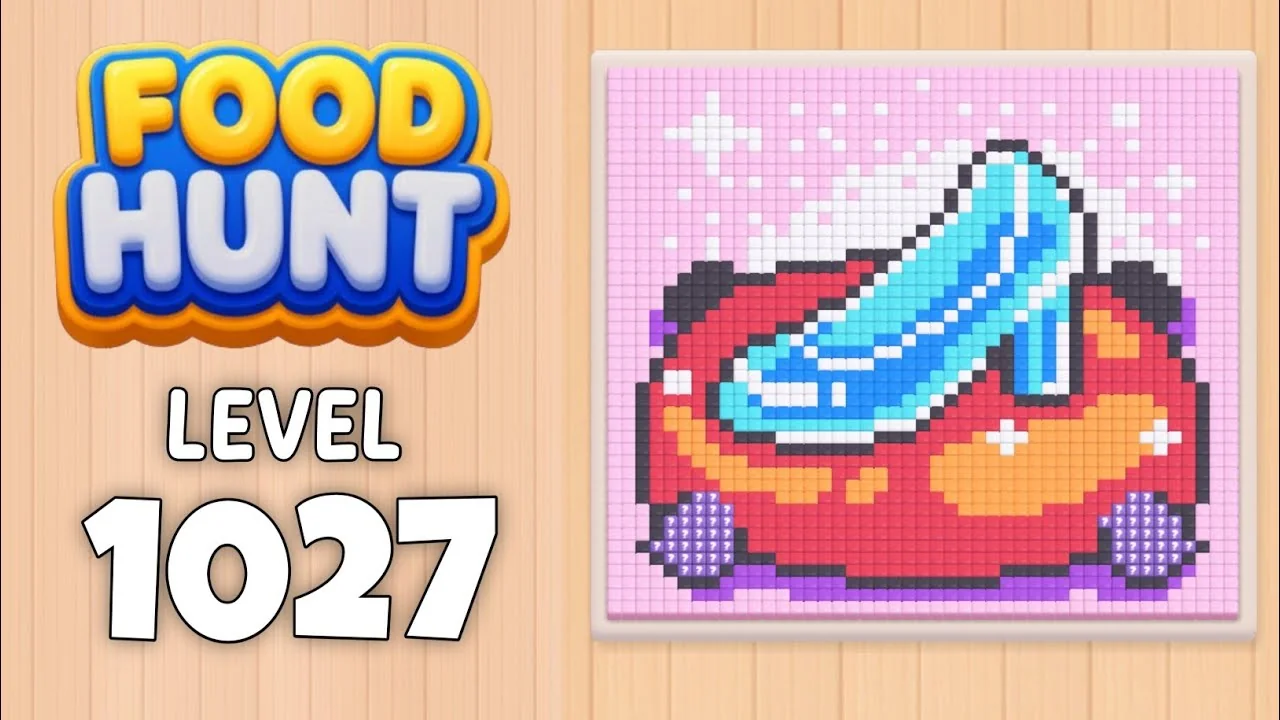
Step-by-step walkthrough
Prefer screenshots to video? Every phase of the clear is below in order, with the block counts and the frames they were taken from — keep it open next to the game and follow along tap by tap.
Level: 1027
Source: frame-by-frame analysis of the Level 1027 recording (559 frames @ 2 fps ≈ 4:39; board empty at 4:36, Level Complete at ~4:39 — timestamps below are video time)
Blocks fed: 37 | Total pixels: 1,886 | Move limit: none — order only affects speed
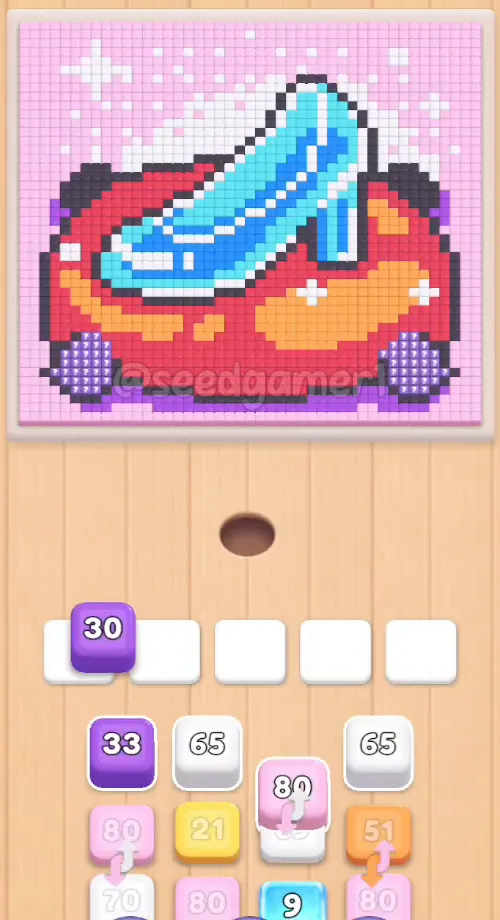
How the Level Works
1. Tap a color block in the bottom queue. Four columns are visible and only the bright top block of each column can be tapped. The block flies into one of the five slots and an ant of that color starts eating. 2. Five slots sit above the queue and all five work from the start — nothing is chained shut on this level. The first five taps go in inside seven seconds, one per slot. 3. A block eats every reachable cell of its own color; the number printed on it counts down as it eats. At 0 the block vanishes and its slot frees — refill the slot immediately, an empty slot is dead time. 4. Blocks get stuck, and this level is built around it. A block whose remaining cells are buried under another color freezes on its number for minutes. Three blocks here sit frozen for 2 to 3 minutes each (see the stall list in Pro Tips). Do not tap extra blocks hoping to hurry them along. 5. Blocks are eaten in layers. The colors that cover large areas — pink (background), red (body), white (snow), charcoal (outline), orange (arches) — come back several times as separate blocks. The first pass takes the cells that are exposed; the next pass takes what the first ant could not reach. That is why the same color reappears again and again. 6. Watch the number, not the color, when a slot is refilled. Five times here a finished block was replaced by a block of the _same_ color, with an empty gap of only one or two frames at 2 fps — short enough that a color track reads the whole stretch as one long block (slot 2 at 0:21, slot 4 at 0:22, slot 2 at 0:36, slot 4 at 3:41, slot 2 at 4:28). The tray number jumping back up is the only cue that a new block has landed. 7. One slot sits idle for long stretches, and that is normal. Slot 2 is empty from 0:50 to 1:27 (37 s) and slot 5 from 1:43 to 2:31 (48 s) — the queue simply has nothing useful left to send, and the colors the other ants would eat are still buried. Two slots never sit empty together for more than six seconds. 8. The very end is a flood. From 4:19 all five slots are running and the last ~450 cells go in fifteen seconds. 9. Eat the whole picture to win. No move limit, no fail state — ordering is about speed, nothing else.
Colors in this level: 🩷 Pink (backdrop) · 🟥 Red (body) · ⬜ White (snowflakes and highlights) · ⬛ Navy (the black outline) · 🟧 Orange (wheel arches and side trim) · 🟨 Yellow (the pale orange-yellow highlights on the arches) · 🟦 Blue (windscreen glass) · 🩵 Cyan (the pale blue sweep across the windscreen) · 🟣 Purple (the two tyres).
Complete Block Order (Which Color First, Then Which)
Timestamps are the moment the block lands in its slot, as positions in the footage (t = (frame − 1) / 2). Count = the number printed on the block when it landed.
Phase 1 — The Opening Five (0:03 – 0:07)
| # | Time | Color Block | Count |
|---|---|---|---|
| 1 | 0:03 | 🟣 Purple | ×30 |
| 2 | 0:04 | 🩷 Pink | ×76 |
| 3 | 0:05 | 🟣 Purple | ×33 |
| 4 | 0:05 | 🩷 Pink | ×78 |
| 5 | 0:07 | ⬜ White | ×65 |
Five taps in four seconds, one per slot: slot 1 → 2 → 3 → 4 → 5. All five slots are working from the very start.
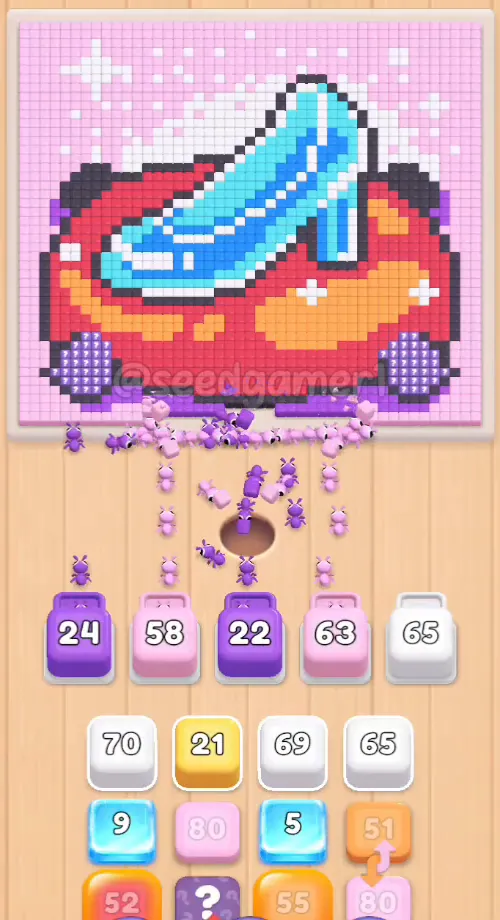
Phase 2 — The Yellow Stall and the First Refills (0:16 – 0:36)
| # | Time | Color Block | Count |
|---|---|---|---|
| 6 | 0:16 | 🟨 Yellow | ×21 |
| 7 | 0:21 | 🩷 Pink | ×77 |
| 8 | 0:22 | 🩷 Pink | ×48 |
| 9 | 0:32 | 🟥 Red | ×54 |
| 10 | 0:35 | 🩵 Cyan | ×35 |
| 11 | 0:36 | 🩷 Pink | ×71 |
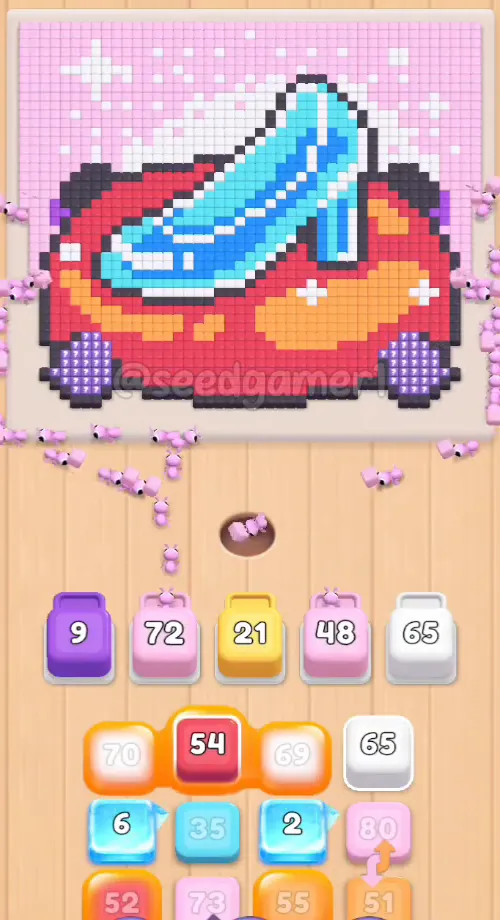
Phase 3 — The Quiet Stretch (1:28)
| # | Time | Color Block | Count |
|---|---|---|---|
| 12 | 1:28 | ⬜ White | ×65 |
| 13 | 1:28 | 🩷 Pink | ×79 |
Slot 2 has been empty since 0:50 and slot 5 gets its pink refill in the same second — these two are the first useful blocks to arrive in a while. From here the board barely moves until 2:31: the cyan ×35, the yellow ×21 and the red ×54 all sit frozen, and slot 5 drains empty again at 1:43 for the next 48 seconds.
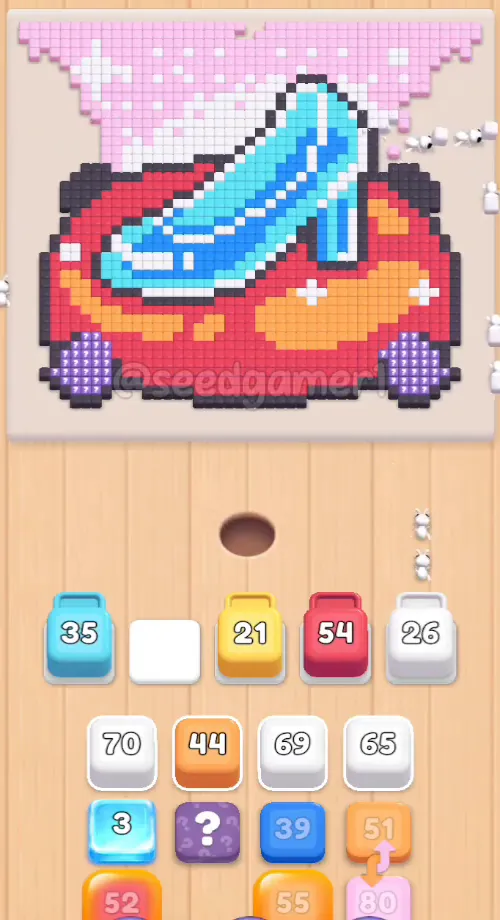
Phase 4 — The Board Wakes Up (2:31 – 2:45)
| # | Time | Color Block | Count |
|---|---|---|---|
| 14 | 2:31 | ⬜ White | ×67 |
| 15 | 2:32 | ⬛ Navy | ×20 |
| 16 | 2:44 | 🟥 Red | ×49 |
| 17 | 2:45 | ⬛ Navy | ×37 |
The long stall of the red ×54 ends here, and four slots turn over inside fifteen seconds. This is the pattern for the whole second half: a slot that empties gets the next useful block immediately.
Phase 5 — Glass, Body and the Long Blue (2:57 – 3:14)
| # | Time | Color Block | Count |
|---|---|---|---|
| 18 | 2:57 | 🟦 Blue | ×11 |
| 19 | 2:59 | 🟧 Orange | ×46 |
| 20 | 3:09 | 🟥 Red | ×49 |
| 21 | 3:14 | 🟥 Red | ×57 |
Phase 6 — Deep Layers (3:22 – 3:47)
| # | Time | Color Block | Count |
|---|---|---|---|
| 22 | 3:22 | 🟧 Orange | ×40 |
| 23 | 3:32 | ⬛ Navy | ×67 |
| 24 | 3:32 | 🩷 Pink | ×66 |
| 25 | 3:42 | 🟦 Blue | ×51 |
| 26 | 3:47 | 🟥 Red | ×17 |
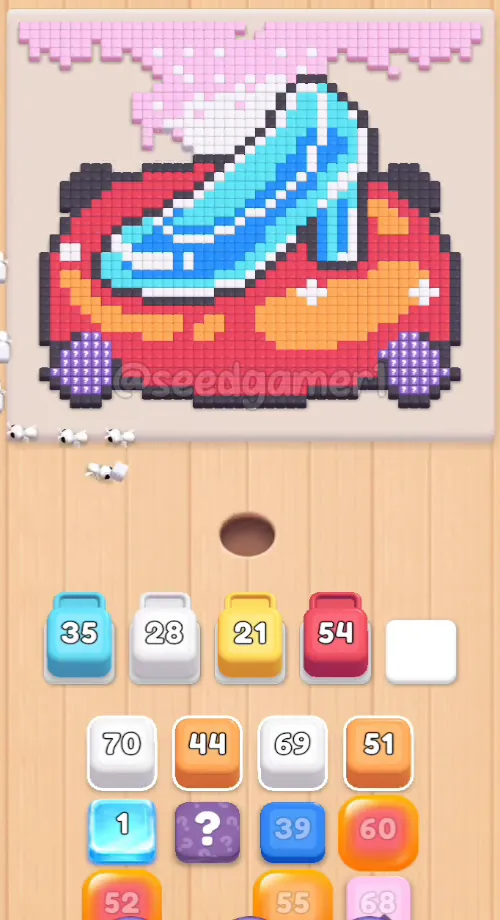
Phase 7 — The Endgame Flood (3:54 – 4:05)
| # | Time | Color Block | Count |
|---|---|---|---|
| 27 | 3:54 | 🩵 Cyan | ×43 |
| 28 | 3:55 | 🟥 Red | ×39 |
| 29 | 3:55 | 🟧 Orange | ×34 |
| 30 | 3:56 | ⬜ White | ×65 |
| 31 | 4:03 | 🟦 Blue | ×38 |
| 32 | 4:05 | 🟧 Orange | ×48 |
| 33 | 4:05 | 🟥 Red | ×58 |
Seven blocks land in eleven seconds. From here five ants run at once and the picture collapses.
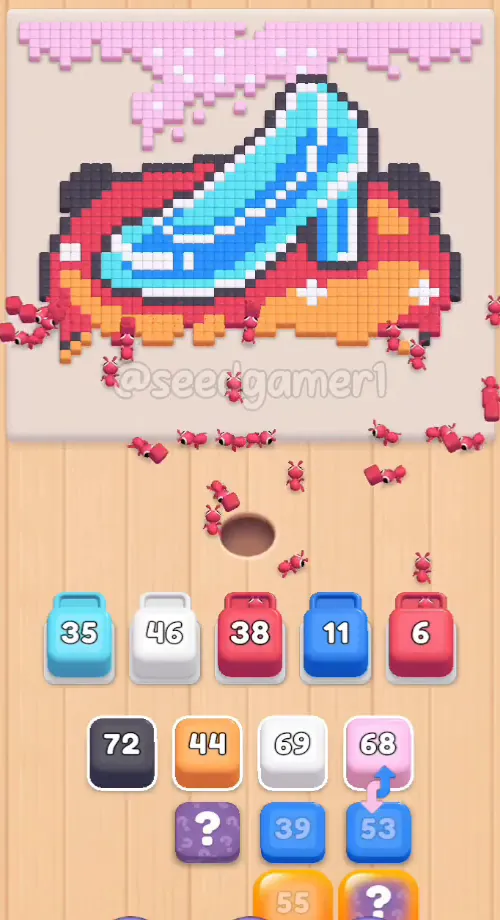
Phase 8 — The Last Pixels (4:10 – 4:28)
| # | Time | Color Block | Count |
|---|---|---|---|
| 34 | 4:10 | 🩷 Pink | ×75 |
| 35 | 4:21 | 🩵 Cyan | ×46 |
| 36 | 4:22 | ⬛ Navy | ×76 |
| 37 | 4:28 | 🩷 Pink | ×55 |
The very last pixels to fall are cyan. Slot 4 (charcoal ×76) empties at 4:31, slot 2 (pink ×55) at 4:33, and the cyan ×46 in slot 1 is the only block still running when the board goes empty at 4:36.
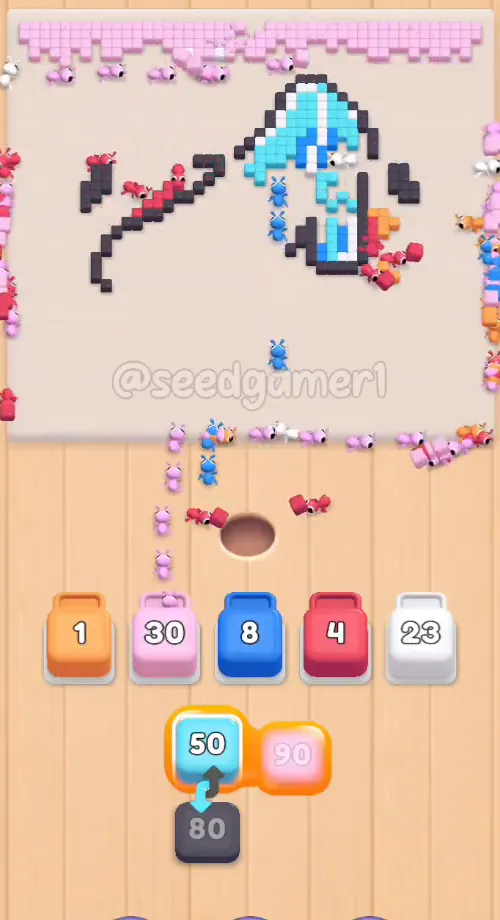
Quick Reference — One-Line Order
Purple 30 → Pink 76 → Purple 33 → Pink 78 → White 65 → Yellow 21 → Pink 77 → Pink 48 → Red 54 → Cyan 35 → Pink 71 → White 65 → Pink 79 → White 67 → Navy 20 → Red 49 → Navy 37 → Blue 11 → Orange 46 → Red 49 → Red 57 → Orange 40 → Navy 67 → Pink 66 → Blue 51 → Red 17 → Cyan 43 → Red 39 → Orange 34 → White 65 → Blue 38 → Orange 48 → Red 58 → Pink 75 → Cyan 46 → Navy 76 → Pink 55
Pro Tips
1. Fill all five slots in the first seven seconds. Steps 1–5 do exactly that: don't wait for anything to clear, every slot works from the start. 2. Open with purple and pink, not with the big red. The purple ×30/×33 (steps 1, 3) are the level's only purple blocks and they finish the tyres in about half a minute. The pink blocks (7 of the 9 come in the first 40 seconds) are what make visible progress on the board early. 3. Expected stalls — do not fight them:
- Yellow ×21 in slot 3, 0:16 → 3:11 (2 min 55 s) — the level's longest block. It sits frozen at ×21 for the first 2 min 34 s, then drains 21 → 0 in twenty seconds once the surrounding red and orange is gone.
- Cyan ×35 in slot 1, 0:35 → 3:53 (3 min 19 s) — frozen at ×35 for a full 3 minutes. This slot is effectively booked for the entire first half.
- Red ×54 in slot 4, 0:32 → 2:44 (2 min 12 s) — frozen until 2:36, then gone in eight seconds.
- White ×65 in slot 5, 0:07 → 1:25 (1 min 18 s) and white ×65 in slot 2, 1:28 → 2:30 (1 min 2 s) and white ×67 in slot 2, 2:31 → 3:48 (1 min 17 s) — the snow layer is always slow; its cells keep getting covered again.
- Blue ×11 in slot 4, 2:57 → 3:41 (44 s) — an eleven-cell block that is frozen for almost its whole life.
These six blocks are where the level's minutes go. All of them release on their own once the covering color is eaten. 4. Longest idle slot: slot 5, empty from 1:43 to 2:31 (48 s). Across that stretch the other four slots are occupied but three of them (cyan ×35, yellow ×21, red ×54) are frozen — only the white ×65 in slot 2 is still nibbling, so the board hardly moves. Nothing you tap there will help: the colors those ants need are still buried. Slot 2 is empty for 37 s early on (0:50 – 1:27) and slot 5 again from 3:45 to 3:56. 5. Feed the same color twice in a row without hesitating. Pink arrives as 76, 78, 77, 48, 71, 79, 66, 75, 55; red as 54, 49, 49, 57, 17, 39, 58; white as 65, 65, 67, 65; charcoal as 20, 37, 67, 76; orange as 46, 40, 34, 48. Each pass digs out the cells the previous ant could not reach. 6. Watch out for instant refills. Five replacements happen with no empty frame at all — slot 2 at 0:21 (pink ×76 → pink ×77), slot 4 at 0:22 (pink → pink ×48), slot 2 at 0:36 (pink → pink ×71), slot 4 at 3:41 (blue ×11 → blue ×51) and slot 2 at 4:28 (pink → pink ×55). The finished block is still drawn, number gone, when the new one lands. For a color track these five look like one long block; the number jumping back up is the only tell. 7. The endgame blocks drain almost instantly. Red ×58, orange ×48, pink ×75 (steps 32–34) and charcoal ×76 (step 36) all land between 4:05 and 4:22 and each drains in under twenty seconds, because by then their cells are fully exposed. This is where the level is won. 8. The last color to finish is cyan. Hold the cyan ×46 (step 35, landed 4:21) for the final free slot — the board home at 4:36. 9. No fail state. Nothing can be lost here; one clean run takes 4:36 of footage (the in-game clock reads 5:34 at the end — the recording plays back a little faster than the game's own timer).
_Compiled from frame-by-frame video analysis: 559 frames (2 fps), per-frame slot tracking with zoom-strip verification of every seat event and its printed count. The seat list is backed by two independent cross-checks: the 37 printed counts sum to 1,886 cells against an art grid of 46 × 40 = 1,840 cells measured off the still picture, and the queue contents were read at intervals and match the seat list in color and order. Five same-slot refills of the same color — which leave no empty frame behind — were found by screening every occupancy run for a count that jumps back up._
_Timestamps are positions in the footage; the board goes empty at 4:36. The recording runs about 1.2× faster than the game's own clock — the HUD timer reads 5:34 at the end — so multiply a timestamp by 1.2 for the elapsed in-game time._
More expert walkthroughs
View all →
Featured walkthroughs
The levels players search for most - each with a full video guide.